
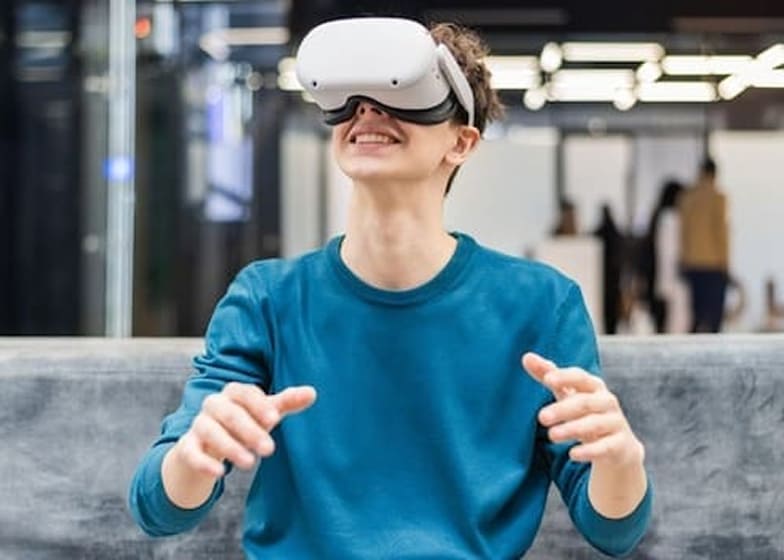
Augmented Reality (AR) and Virtual Reality (VR) are two technologies that are transforming how we interact with digital content. Although they are often mentioned together, they are distinct technologies with different applications, experiences, and benefits.
- Both AR and VR are driving innovation in gaming, education, healthcare, marketing, and more.
- Understanding the differences helps individuals and businesses adopt the right technology for their goals.
Understanding Augmented Reality (AR)
AR overlays digital information on the real world using devices like smartphones, tablets, or AR glasses.
- Enhances real-world surroundings with digital content.
- Can be experienced without fully immersive hardware.
- Interactive and context-sensitive.
Understanding Virtual Reality (VR)
VR creates a fully immersive digital environment where users feel completely “inside” a virtual world.
- Requires VR headsets or goggles.
- Fully immersive and interactive.
- Users are isolated from the real world while in VR.
How AR and VR Are Used in Different Industries
Gaming and Entertainment
- AR: Pokémon Go blends digital creatures with real-world locations.
- VR: Immersive gaming worlds where players interact fully with digital environments.
Education and Training
- AR: Anatomy apps overlay organs on human bodies for medical students.
- VR: Virtual classrooms or flight simulators for realistic training experiences.
Retail and Marketing
- AR: Customers visualize furniture or clothes in their own environment.
- VR: Virtual showrooms for immersive shopping experiences.
Healthcare
- AR: Surgeons use AR overlays to guide procedures.
- VR: Pain management, therapy, and rehabilitation using immersive environments.
Real Estate
- AR: Visualize property modifications or furniture placement.
- VR: Take a full virtual tour of homes without physically visiting them.
Advantages of AR and VR
Advantages of AR
- Enhances real-world experiences without complete immersion.
- Easily accessible on smartphones and tablets.
- Ideal for tasks requiring real-world context, such as navigation or repair.
Advantages of VR
- Provides highly immersive and engaging experiences.
- Ideal for training simulations where real-world risks are high.
- Enhances creativity and exploration of fully digital environments.
Challenges and Limitations
AR Challenges
- Limited field of view with some devices.
- May require strong internet connectivity.
- User interface design must integrate with the real world seamlessly.
VR Challenges
- Expensive hardware requirements.
- Motion sickness or discomfort for some users.
- Isolation from the real world may limit practical daily use.
Future Potential of AR and VR
- AR: Growth in wearable AR glasses for everyday tasks, industrial applications, and marketing.
- VR: Expansion in immersive learning, virtual offices, and social VR platforms.
- Integration: Combining AR and VR (mixed reality) for hybrid experiences in gaming, healthcare, and training.
Conclusion
- AR overlays digital content onto reality; VR immerses users in a fully virtual environment.
- Both have unique applications across gaming, education, healthcare, retail, and more.
- Challenges include hardware costs, accessibility, and user experience limitations.
- Future trends point to integrated AR/VR experiences enhanced by AI, IoT, and 5G.
By understanding the differences and potential of AR and VR, individuals and businesses can leverage these technologies for innovation, engagement, and efficiency.
